Compare the feature, not just the process name
CNC describes computer control, so Wire EDM can also be CNC-controlled. Here the comparison is between milling with a rotating cutting tool and conventional through-wire electrical discharge machining, which removes conductive material by electrical discharges. The feature and its access usually make the first distinction.
| Your requirement | CNC milling | Wire EDM |
|---|---|---|
| Accessible pocket with a floor | A rotating cutter can remove material to a specified depth, subject to tool access. | A through-wire path is needed; do not assume Wire EDM can produce a blind cavity. |
| Internal or external through-profile | Review cutter diameter, reach, workholding and the required internal radii. | Review wire access, part thickness, start-hole or edge entry and the profile requirements. |
| Material | Metals and engineering plastics can be considered for a suitable cutting route. | Conventional Wire EDM requires an electrically conductive workpiece; ordinary non-conductive plastics are not suitable. |
| Small internal corner radius | The round cutter and its access constrain the achievable internal corner. | Wire diameter and the discharge gap still leave a finite internal radius. |
| Hardened conductive material | Review tool suitability, geometry and material condition. | Spark erosion can be useful where material hardness makes conventional cutting difficult. |
| Several feature types on one part | Faces, pockets and drilled features may form part of the machining sequence. | A detailed profile can be reviewed as another operation in the complete route. |
These are general process distinctions. Equipment setup and the actual drawing determine whether a feature is feasible. See the technical references.
Can Wire EDM make a perfectly square internal corner?
Wire EDM can be considered for smaller internal radii than a practical milling setup can reach, but it does not create a mathematical zero-radius internal corner. The wire has a diameter and cuts across a discharge gap. Milling also leaves an internal radius because its cutter is round.
Specify the largest internal radius your design permits and how the mating part must fit. Do not write only “sharp corner”. If a relief or design change is acceptable, identify it for discussion; the design owner must approve a change before manufacture.
References: Sodick manual, printed pages 2 and 60 and Protolabs on milling radii.
Is the opening through the part or a blind pocket?
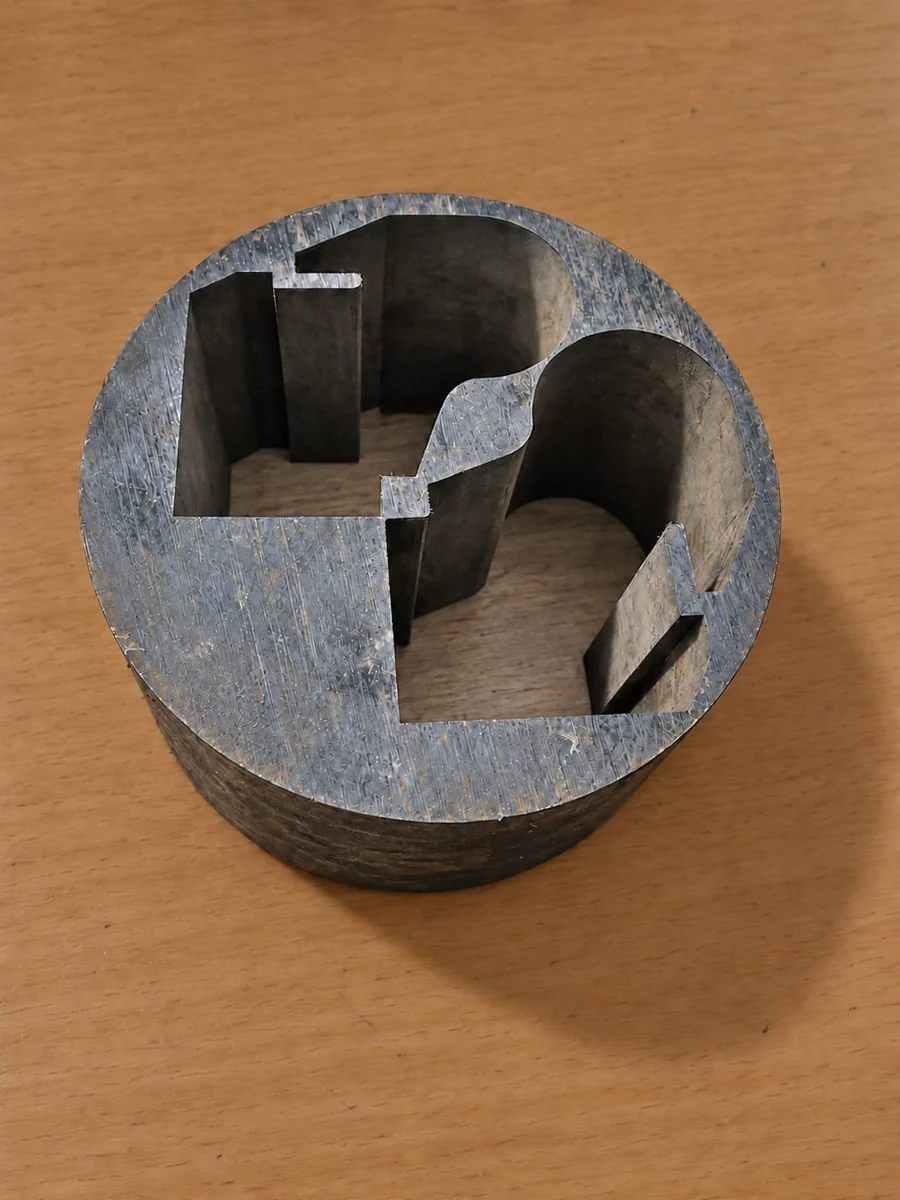
A through-opening continues through the workpiece. A blind pocket retains a floor. Wire EDM needs a path for the wire through the workpiece; an enclosed internal profile normally needs a suitable start hole, while an external profile can be approached from an edge.
Blind pocket
Through-opening
For an accessible blind pocket, discuss milling and the permitted corner geometry first. Sinker EDM uses a shaped electrode and is a different process. A supplier offering Wire EDM should not automatically be assumed to offer sinker EDM, or to be able to machine every blind cavity. Makino explains the different EDM processes.
Two examples to frame the drawing review
These are illustrative requirements, not accounts of completed Suguna jobs. They show which questions to ask before selecting a route.
A housing with a recessed pocket
The pocket has a floor, mounting holes and surfaces that must locate a mating part. Start the review with cutter access, pocket depth, acceptable corner radii and datum relationships. A preference for square corners alone does not make it a Wire EDM job.
Review CNC milling capabilitiesA conductive plate with a narrow through-profile
The opening passes through the plate and has a small permitted internal radius. Ask for Wire EDM review with material condition, thickness, wire entry, the profile drawing and edge-finish requirements. Other faces or holes may still need milling or drilling.
Review Wire EDM capabilitiesWhich process is cheaper or more accurate?
The best fit depends on your part’s material, shape, quantity and required tolerances. Milling suits many pockets, faces and holes, while Wire EDM is useful for fine through-profiles and small internal radii in conductive materials. Share your drawing and tell us which features matter most—we’ll review a suitable manufacturing route for your part.
Discuss milling and Wire EDM with Suguna
Suguna Engineering Works offers CNC milling and Wire EDM from Balanagar, Hyderabad. The service pages show our existing equipment references and work photographs. Machine travel is not a guarantee of usable part capacity; thickness, clamping, access and drawing requirements still need review.
You can enquire from Hyderabad, another Indian city or an international destination. Share what you have: a drawing or model, material and condition, overall dimensions, thickness, quantity, critical features, finish, inspection needs and receiving postcode. Highlight whether the feature is blind or through, and the internal radius your design permits.
Contact the team first if an NDA is needed. The free initial DFM call is up to 25 minutes; feasibility, scope, pricing and timing are confirmed for the actual requirement.
Technical references
- Makino: EDM process and types
Conductive materials, difficult features and the distinction between wire, sinker and hole-drilling EDM.
- Sodick Wire EDM training manual (PDF, hosted by MIT)
Process principles, wire diameter and internal radii, and wire offset including the spark gap; see printed pages 1–2 and 60.
- Protolabs: complex features on machined parts
Milling tool access, deep features and internal corner constraints.
These references explain general process principles. Their machine specifications, tooling limits, production rates and advertised capabilities are not Suguna specifications.